Tractor Pull Insurance
A tractor pull puts the loudest, highest-energy machines in motorsport a short barrier away from a grandstand. The placement lives or dies on the track plan, the sled, and who has actually agreed to carry the competitors. Getting those three questions answered in writing before the season starts is what separates a smooth renewal from a scramble every time a new venue is added to the schedule.
- 01
Barrier and setback specification by machine class
- 02
Weight transfer sled condition and operation
- 03
Competitor cover: sanctioning body or arranged separately
- 04
Pit, perimeter, and alcohol separation
The underwriting problem
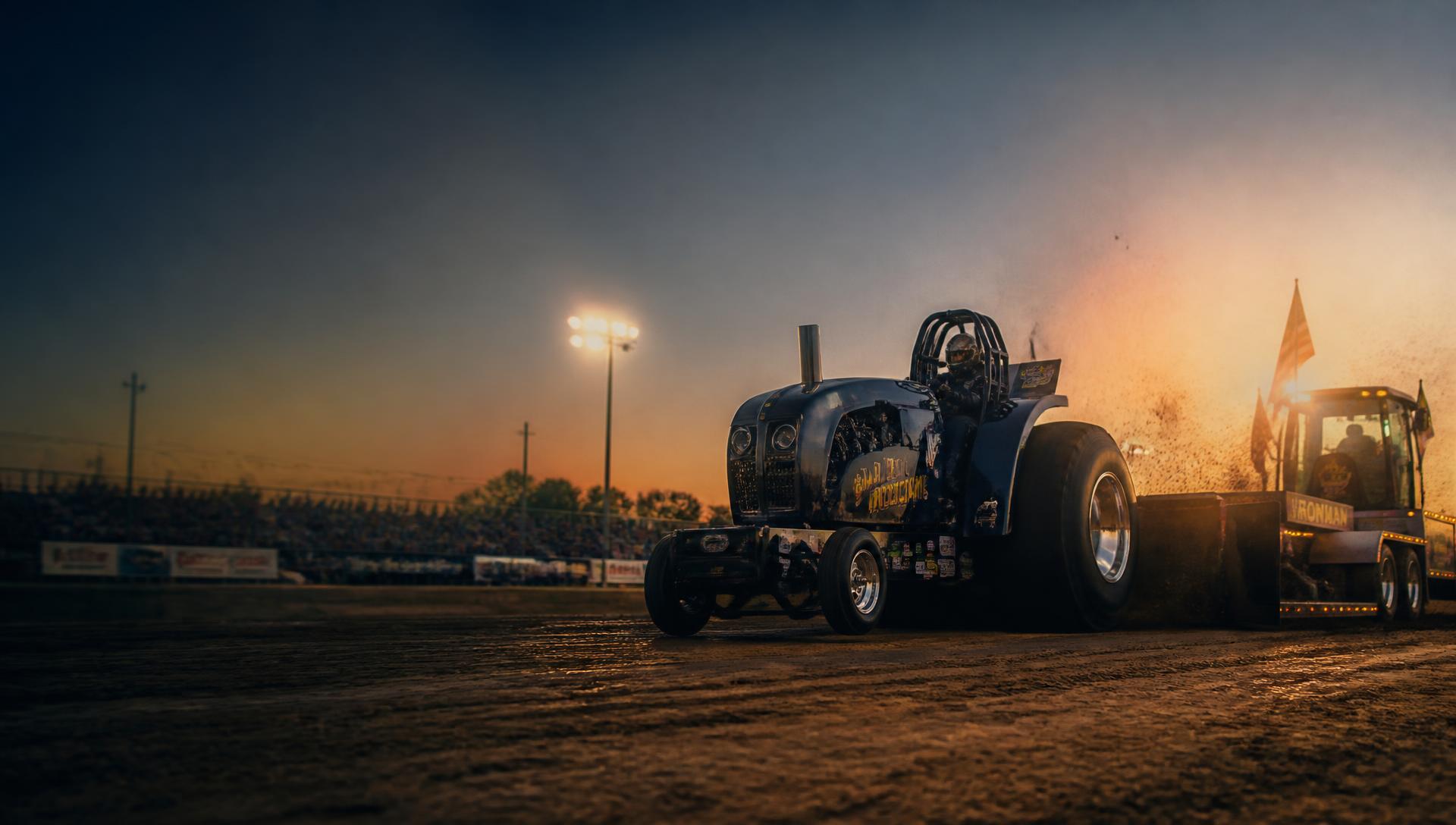
A tractor pull runs engines far beyond their design limits, ten meters from a grandstand full of families.
Component failure is not an outlier here; it is the expected behavior of the machinery. Underwriters price the containment: shielding certification, track and shutdown geometry, spectator setback, and the participant waiver and release chain behind the pit gate. The submissions that move fastest are the ones that treat the track plan as a working safety document rather than a formality attached after the venue is already booked, because that plan is what an adjuster reconstructs first after any loss.
- Severity driver
- Catastrophic engine and driveline failure
- Rating lever
- Shielding standards and spectator setback
- Overlooked hazard
- Pit access by non-participants
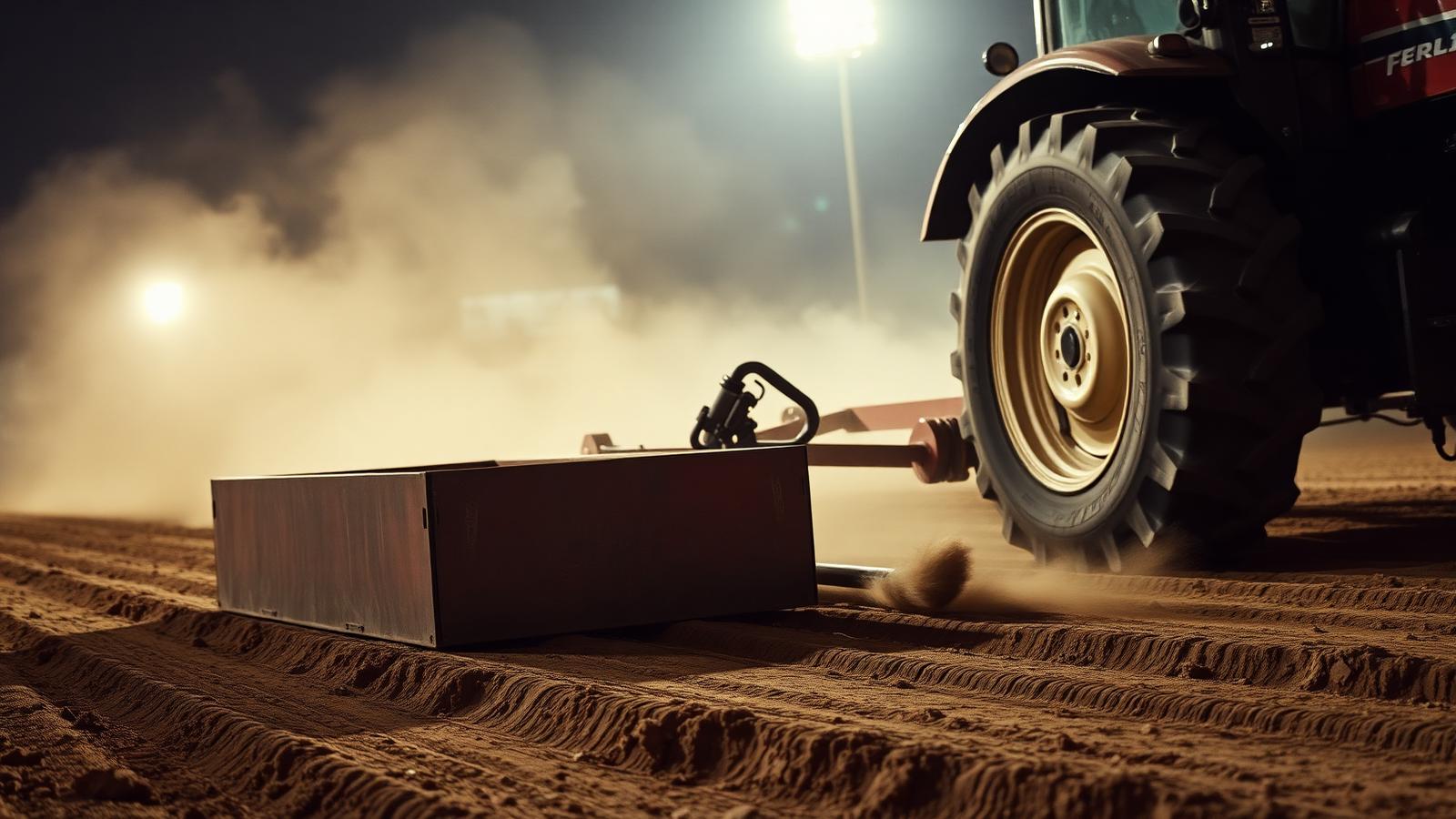
Stored energy, a dirt track, and spectators at the rail
Driveline failures throw parts. Track design, shielding standards, and pit access control are what an underwriter reads before the attendance figure.
- Shielding specification expected on competing machines
- SFI
- Pit area with credentialed access only
- Fenced
- Independent shut-down authorities on the track
- 2
Direct answers
What pull promoters ask first
What is tractor pull insurance?
Liability written for a tractor or truck pulling event on a motorized-competition-aware form. It covers the organizer's exposure to spectators, the site, and third parties, with competitor injury handled through a sanctioning body program or a separately arranged participant accident line.
Who needs it?
County and state fairs running a pull, independent pull promoters, fairgrounds hosting traveling pull series, and sanctioning bodies covering their own sanctioned calendar.
What is the organizing document?
The track plan: barrier specification, setbacks by class, spectator and pit boundaries, sled staging, and emergency access. It is the document underwriters read first and the one that most often decides whether a quote is offered.
Does homeowners or farm liability cover a private pull?
No. A homeowners or farm liability policy is written for the owner's household and farming operations, not for a competitive event held on that land, and it typically excludes business pursuits and motorized competition outright, leaving a private landowner hosting a pull with no coverage unless an event policy is placed separately.
How is the rate typically structured?
Pull event rates are typically built from a base per-event or per-day premium adjusted by attendance, machine class mix, and barrier compliance, then layered with participant accident and property lines priced separately, rather than a single blended figure covering every exposure at once.
Site
The track plan is the underwriting document
01
Pit and staging
Competitor machines, fuel handling, crews, and public or sponsor access mixing in one area.
- Fuel rules
- Crew wristbands
- Public exclusion
02
Track approach
Machines entering the track, weight transfer sled connected, final safety inspection before the pull.
- Tech inspection
- Kill switch check
- Sled connection verified
03
The track
300+ feet of track with setback barriers on both sides and a clear overrun beyond the end.
- Barrier spec by class
- Setback measured
- Overrun kept clear
04
Spectator areas
Grandstands and ground viewing behind barriers, with concessions and pedestrian routes behind them, sized against the largest projected gate rather than a typical weeknight crowd.
- Fixed barriers
- Steward posts
- Emergency lanes clear
Structure
Fair-run pull or sanctioned event
Option A
Sanctioned pull
Run under a pulling association
- Competitor cover through the sanctioning body program
- Rule book defines barriers, tech inspection, and classes
- Trained sled operator and officials travel with the series
- Organizer's exposure is primarily spectator and site
- Certificates flow from the body to each host venue
Option B
Fair-run / independent pull
Organized directly by the fair or promoter
- All three exposures sit with the organizer
- Competitor accident cover must be arranged explicitly, typically through a stand-alone participant accident policy quoted per event
- Barrier and tech standards are the organizer's own decision, so they need to be documented and defensible rather than assumed
- Sled often hired, with the operator a key-person question that the hire agreement needs to answer directly
- Narrower market and higher rate for the same gate, because the underwriter is pricing an unproven safety program rather than an established rule book
Underwriting
What sets a pull rate
| Underwriting factor | Why it matters | How it can change appetite |
|---|---|---|
| Machine classes entered | Antique farm-stock and unlimited modifieds are different risk classes sharing a venue. | High-output classes drive the barrier requirement and frequently need a motorsport market rather than an event market. |
| Barrier plan and setbacks | Crowd-side distance and barrier construction determine the spectator severity profile. | Setbacks below the sanctioning body's standard for the fastest class are a routine decline reason. |
| Sled and its operator | The weight transfer sled controls the load every machine works against. | Documented maintenance and an experienced named operator are direct credits. |
| Competitor cover arrangement | Whether participants are covered and by whom decides the organizer's residual participant exposure. | Sanctioned events with a body program are materially easier to place than open-entry fair pulls. |
| Attendance and site layout | Grandstand capacity, pit access, and parking drive the non-track frequency exposure. | Large gates with limited emergency access or a single egress route attract closer scrutiny. |
| Alcohol and evening operation | Evening pulls under lights with licensed areas need separation from pit and perimeter. | Alcohol access to pit or track perimeter is a common exclusion trigger in claim disputes. |
| Track history and prior loss experience | A track that has hosted pulls for a decade with clean loss runs demonstrates a working safety culture that a first-year venue cannot yet show. | Clean multi-year loss runs are a meaningful credit; a prior spectator or competitor claim at the same venue draws close underwriting scrutiny regardless of how long ago it occurred. |
| Medical and emergency response on site | Time to first aid after a component failure or fire is a direct driver of injury severity, and rural fairground sites can sit well outside standard ambulance response windows. | An on-site EMT unit and a written mutual-aid agreement with local emergency services are treated as material mitigants rather than nice-to-haves for rural venues. |
| Entry list volume and elimination format | A large field run through a bracket elimination format keeps every machine on the track longer across the day than a small exhibition field with a handful of passes. | Larger fields with elimination rounds extend exposure hours and are rated accordingly, particularly where the same barrier and stewarding staff cover the entire card without relief. |
| Weather contingency and surface management | Rain reworking a dirt track mid-event changes traction unpredictably between runs, and a promoter without a clear go/no-go standard can end up running unsafe surface conditions to protect the gate. | A written surface and weather standard, with authority to pause or stop competition, is viewed favorably; running through deteriorating conditions to avoid refunding tickets is viewed as a governance gap. |
Coverage
The event program, layer by layer
Event liability — motorsport form
Spectator and site liability written on a form that contemplates motorized competition rather than excluding it.
Confirm the fair blanket excludes the pull first
Participant accident and liability
Competitor injury, via the sanctioning body program where one exists, or arranged directly for independent pulls.
Property — sled, barriers, equipment
The sled, barrier stock, timing equipment, and PA, including in transit for traveling series.
Liquor liability
Scheduled where the fair or promoter holds the license, with documented separation from pit and track.
Volunteer accident
Track marshals, flag personnel, and gate staff, most of whom are unpaid at fair-run events.
Event cancellation
Weather and track condition are the dominant causes, with fixed cost in sled hire, officials, and promotion.
Umbrella / excess
Commonly required by fairgrounds and municipalities above the primary limit.
Inland marine / equipment in transit
Sled, barrier stock, timing gear, and spare shielding while a traveling series moves between fairground stops.
Medical payments
Small first-dollar medical coverage for a spectator or bystander injury regardless of fault, used to resolve minor claims without a liability dispute.
Loss control
Where pull claims come from
Hazard
Wheel, axle, or component failure throwing debris toward the crowd.
Control
Tech inspection including driveline restraints, plus setback and barrier spec matched to the fastest class entered.
Hazard
Sled malfunction or connection failure mid-pull.
Control
Documented sled maintenance, connection verified before every pull, and an experienced named operator.
Hazard
Member of the public in the pit area during hot work.
Control
Wristband access control, crew-only zones during fuel and repair work, and stewarded pit gates.
Hazard
Competitor injured with no cover in place.
Control
Participant accident arrangement confirmed in writing before entries open, not assumed from the rule book.
Hazard
Vehicle leaves the track into the overrun.
Control
Kill switch tested at tech inspection, overrun kept clear of vehicles, people, and equipment all day.
Hazard
Fire from a ruptured fuel line or overheated turbo during a run.
Control
Fuel cell and line inspection at tech, an on-track fire crew with suppression equipment staged, and a rehearsed driver extraction plan.
Hazard
Crowd surge or unauthorized crossing toward a stalled machine.
Control
Stewards posted at fixed intervals along the barrier line with instructions to hold the crowd back until the all-clear is given by the track marshal.
Claims scenario
What a driveline failure actually costs
A modified class machine sheds a driveshaft roughly a hundred feet down the track. The piece clears the barrier at a point where the setback met the sanctioning body's minimum for antique classes but not for modifieds, because the track was measured once for the slowest class entered and never re-checked against the fastest. A spectator in the third row is struck. The organizer's event liability responds to the bodily injury claim, but the investigation that follows turns almost entirely on the track plan on file at binding: what setback was represented, what was actually built, and whether the class list matched what was disclosed to the underwriter.
A second, quieter scenario plays out just as often. A sled connection is not fully engaged before a pull, the machine lurches, and the operator is thrown from the seat. Because the sled was hired for the weekend with an operator supplied by the rental company, three parties end up disputing responsibility: the fair that hired the equipment, the rental company that supplied both machine and operator, and the sanctioning body whose rule book covers competitors but not hired equipment operators. A written hire agreement naming who carries the operator's injury exposure resolves this before it becomes a dispute rather than after.
A third pattern shows up on the claims side more often than promoters expect: a spectator climbs a fence line to get a closer photo of a modified machine staging for its run, and is struck by debris that would never have reached the sanctioned viewing area. Because the barrier plan on file with the underwriter specified a fixed, continuous barrier rather than a partial fence with gaps, the investigation turns on whether the barrier actually built at the event matched the drawing submitted at binding. A photograph of the completed barrier line, taken and dated before gates open, is one of the cheapest pieces of evidence a promoter can produce and one of the most persuasive in a later coverage dispute.
Contracts
The agreement chain
Layer 01
Fairground or venue
- Typically asks for
- AI status, stated limits, and ground restoration terms for the track surface.
- Where it goes wrong
- Track cut into the fairground surface without a restoration agreement, billed after the event.
Layer 02
Sanctioning body
- Typically asks for
- Sanction agreement defining who carries competitor cover and which rule book governs barriers and tech.
- Where it goes wrong
- Both parties assume the other's program covers the competitors.
Layer 03
Competitors
- Typically asks for
- Entry-form indemnity, tech compliance, and evidence of participant cover where required.
- Where it goes wrong
- Entry indemnities that are unenforceable against minors or unsigned at the gate.
Layer 04
Sled and equipment hire
- Typically asks for
- Operator qualification, machine condition, and liability split while the sled is on the host's site.
- Where it goes wrong
- Hired sled operated by an unvetted operator supplied with the hire.
Layer 05
Local emergency services
- Typically asks for
- Mutual-aid or standby agreement covering ambulance response time and fire suppression support for the event.
- Where it goes wrong
- No written standby arrangement, leaving response time dependent on a general county dispatch queue during a multi-thousand-attendee event.
Season calendar
How a pulling season is structured
Off-season
Rule book confirmation
Sanctioning body or house rules finalized for the coming season, including barrier and setback standards by class.
4–6 months out
Venue and date booking
Fairground or track dates confirmed, sled hire arranged, and track plan drafted for each scheduled stop.
2–3 months out
Placement
Event liability, participant cover arrangement, and property lines bound against the finalized track plan and class list.
Event week
Tech and safety walk
Tech inspection, barrier and setback verification, and a final walk of the pit, track, and overrun before entries open.
Day of
Event day operation
Sled connection checks, kill-switch verification per run, and stewarding held to the plan through every class.
Following weeks
Post-event review
Incident log closed out, loss runs updated, and any track or barrier adjustment carried into next season's submission, along with a debrief on whether stewarding levels and medical response actually matched what was planned versus what happened on the day.
Submission
The submission that gets quoted first
014 items
The event
- Venue, dates, and projected gate per performance
- Machine classes entered and their rule book
- Track plan with barriers, setbacks, and overrun
- Sanctioning body involved, if any
024 items
Equipment and people
- Sled specification, maintenance records, and operator
- Officials, marshals, and stewarding numbers
- Tech inspection procedure and kill switch protocol
- Emergency plan and medical provision
036 items
Arrangements
- Competitor cover arrangement in writing
- Alcohol service plan and separation from pit and track
- Entry form and competitor indemnity
- Loss runs for prior editions
- Mutual-aid or standby agreement with local emergency services
- Transit and storage arrangement for the sled and barrier stock between stops
Routing
Where pulls overlap
Annual event promoter insurance
You promote a series of pulls or mixed events across a season.
Special event insurance
The fair itself, with the pull separately endorsed or excluded.
Paintball event insurance
Another competitor-participant attraction on the same fair program.
Motorsport insurance
The venue runs other motorized competition across the year.
Glossary
Pulling event language, translated
Sanctioning body
A pulling association that sets the rule book — classes, tech standards, barrier specification — and often carries a participant accident program its member competitors are covered under.
Participant accident coverage
Insurance responding to a competitor's own injury while pulling. It sits apart from the organizer's general liability, which responds to spectators and third parties, not to the people competing.
Additional insured (AI)
A fairground, municipality, or sanctioning body added to another party's liability policy so a claim against them is defended and paid under that same policy.
Setback
The measured distance between the track and the nearest spectator area, sized to the fastest, highest-output class actually entered rather than to the average machine on the card.
Hold harmless / indemnity
A contract clause where one party agrees to cover another's losses arising from the event. Signing one broader than the underlying policy actually funds is a common and costly mistake.
Umbrella / excess liability
A layer of coverage sitting above the primary liability limit, frequently required by fairgrounds and municipalities before they will host a motorized competition event.
Shielding certification
A documented standard, typically referencing a recognized safety body's specification, confirming a competing machine's driveline and flywheel are enclosed to contain a component failure rather than letting it become flying debris.
Overrun
The cleared distance beyond the end of the track where a machine can safely coast to a stop after finishing or losing traction, kept free of vehicles, crew, and equipment for the entire day of competition.
Related coverage
Explore Coverage
Guides & resources
FAQ
Tractor pull questions
Is a tractor pull covered under a fair's general event policy?
Usually not. Motorised competition is a standard exclusion on most event forms, so a pull is either separately endorsed or written as its own motorsport-style placement. Fairs that assume their fair blanket covers the pull are the single most common coverage gap on this class.
Who covers the competitors?
Competitors are participants, not spectators, and their injury is a participant exposure. Under a sanctioned pull, the sanctioning body's participant accident and liability program usually covers them; unsanctioned or fair-run pulls need to arrange competitor cover explicitly, because their vehicle policies do not follow the machine onto a competition track.
What determines the barrier requirement?
Track length, machine class, and the sanctioning body's rule book. Modified and pro-stock classes reaching high wheel speed need substantially greater setback and barrier specification than antique or farm-stock classes. Carriers read the barrier plan against the fastest class entered, not the average.
Does the sled operator carry separate risk?
Yes. The weight transfer sled is specialized equipment, its operator is a key person, and a sled malfunction mid-pull is a direct cause of mechanical failure and crowd-side incidents. Sled condition, maintenance records, and operator experience are all underwriting items.
What about alcohol at a pull?
Licensed areas need to be physically separated from the pit and track perimeter, with a stated policy on competitor drinking. An intoxicated competitor in a modified machine is an exclusion-triggering scenario that ends placements.
How does track surface condition factor into underwriting?
A dry, hard-packed track with no traction changes wheel spin and debris throw differently than a freshly watered surface. Carriers ask about the track preparation routine — watering schedule, disking depth, and whether the surface is groomed between classes — because inconsistent prep is a documented cause of loss of control.
Do traveling pull series need coverage at every stop?
Yes. A series moving between fairgrounds needs each host venue and municipality added as additional insured for its specific date, not a single blanket certificate assumed to travel automatically. Confirming the certificate process before the season starts avoids a scramble the week of each stop.
What is the exposure during time trials or practice runs?
Practice and time-trial sessions often run with a smaller crowd and looser stewarding than the sanctioned event itself, which is exactly when barrier discipline tends to slip. Underwriters increasingly ask whether practice sessions run under the same track plan and staffing as the main event, or under a reduced one.
What does 'additional insured' mean for a fairground hosting a pull?
It means the fairground is added as a named party under the organizer's or sanctioning body's liability policy, so a claim arising from the pull is defended and paid from that policy directly, instead of the fairground needing to fall back on its own coverage or an after-the-fact indemnity promise.
Why do carriers ask about the setback for every class, not just the fastest one?
Because a track built to a single setback measurement is often set for the slowest class entered and never re-verified once faster classes are added to the entry list. A setback that is adequate for an antique tractor is routinely inadequate for an unlimited modified, and carriers price against the worst case actually on the schedule.
Does a diesel smoke or sled-pulling exhibition need different underwriting than a competitive pull?
Yes. Exhibition passes with no scored competition and no side-by-side racing carry a narrower loss profile than a bracket-style elimination pull, because there is no incentive to push a machine past its tuned limit chasing a place. Carriers still want the same barrier and shielding standard, but frequency assumptions and rate differ meaningfully between the two formats.
How does a multi-day pull change the submission?
A multi-day event multiplies exposure days without necessarily multiplying staffing, so underwriters ask whether stewarding, tech inspection, and medical coverage repeat in full each day or are compressed after day one. A submission that shows consistent daily procedure across every day of the run is priced more favorably than one that only documents opening day.
What happens if a competitor's machine catches fire on the track?
Fire suppression equipment at the track and pit, a trained fire crew on standby, and a clear evacuation lane for the driver are the controls underwriters expect. The organizer's event liability responds to any spectator or third-party harm from smoke, debris, or a spreading fire, while damage to the competitor's own machine sits with the competitor.
Are junior or youth pull classes underwritten differently?
Yes, materially. A youth or junior tractor pull class introduces minors as competitors, which raises questions about parental waiver enforceability, reduced-scale equipment standards, and closer adult supervision requirements at the pit gate. Carriers frequently require a distinct age-appropriate rule set and dedicated stewarding before extending the main policy to cover a junior class.
Does the promoter need cargo or transit coverage for hauling the sled between stops?
A traveling series hauling its own weight transfer sled and barrier stock between fairgrounds carries a transit exposure separate from the event-day property line, since a highway accident or theft from a staging yard between stops is not automatically picked up by a policy written only for the event dates and venue.
What class-code reasoning do underwriters apply to a tractor pull submission?
Pulls are typically rated off a motorsport or specialty exhibition class code rather than a generic special event code, because the class code drives which policy forms and exclusionary language are even available to quote from. Submitting under a general fair or festival code and hoping the pull is picked up incidentally is a frequent reason quotes come back with the pull explicitly carved out.
How does spectator seating type change the underwriting view?
Fixed grandstand seating set back behind an engineered barrier reads very differently than ground-level lawn viewing along a rope line, because lawn viewing puts spectators closer to the track and gives stewards less physical separation to work with if a crowd surges toward the barrier during a close run. Carriers frequently ask for a seating diagram alongside the track plan for exactly this reason.
Can a promoter self-insure the sled instead of carrying property coverage on it?
Technically yes, but a self-funded replacement plan rarely holds up in practice, since a totaled sled mid-season can end a traveling series' remaining dates if there is no fast path to a replacement machine. Scheduled property coverage with a defined replacement-cost basis is the more common and more resilient structure for series that depend on a single piece of specialized equipment.
What is the practical difference between a decline and a restrictive endorsement on a pull submission?
A decline means no carrier in the market being approached will offer terms at all, usually because the barrier plan or competitor cover arrangement is missing entirely. A restrictive endorsement means terms are offered but with a named exclusion, such as excluding a specific unlimited class or excluding night sessions, which is a workable outcome if the promoter is willing to adjust the event to fit the terms offered.
How should a first-year pull promoter with no loss history approach the market?
Lean on the sanctioning body's established rule book and safety record rather than trying to write bespoke house rules for a first event, since a first-year promoter running under a recognized body's standards is a materially easier submission than one asking an underwriter to evaluate an entirely new, unproven safety program from scratch.
Does an indoor arena pull carry a different risk profile than an outdoor fairground pull?
Yes, significantly. An indoor arena concentrates exhaust, noise, and debris within a fixed enclosed structure, which changes ventilation and containment requirements even though the barrier and setback distances may look similar on paper, and carriers typically ask for the venue's own event rules alongside the promoter's track plan before quoting an indoor date.
What documentation should a promoter keep after the event closes for renewal purposes?
Photographs of the completed barrier line dated before gates opened, the final tech inspection sheet for every competing machine, the incident log even where nothing serious occurred, and attendance figures by session. Underwriters weigh a clean, well-documented file far more heavily at renewal than a promoter's verbal assurance that the event ran safely.
How do carriers treat a pull that shares a fairground weekend with unrelated attractions?
Each attraction on the fairground calendar is generally underwritten on its own exposure, but a shared weekend still needs a combined site plan showing how pedestrian flow between the pull, midway rides, and vendor rows is separated, since a pull crowd and a midway crowd converging on one narrow walkway is its own documented cause of loss.
Send the track plan and the class list
Barrier spec against the fastest class, plus who is carrying the competitors, decides the shape of this placement. Send both, along with the sled specification and your prior season's loss runs, and we will map the program against carriers who actually write motorized competition rather than exclude it after the fact.
General information about how pulling event placements are commonly structured. Sanctioning body rules and venue requirements vary. Nothing here is a quote, binder, or confirmation of coverage. Barrier specifications, participant cover arrangements, and sanctioning body rule books referenced above are illustrative of common practice across the pulling industry and should be verified against the actual rule book and venue requirements governing your specific event before any placement decision is made.