EV / 07 · Underwriting file
U-Pick Farm Insurance
U-pick hands the harvest to untrained visitors and then loses sight of them across acres of uneven ground. The insurance question is not whether that is risky — it is which controls make the risk legible to an underwriter.
- 01Ladder and reach-height policy as the severity lever
- 02Field consumption, allergens, and produce liability
- 03Pesticide re-entry intervals and block closures
- 04Supervision over dispersed acreage
The underwriting problem
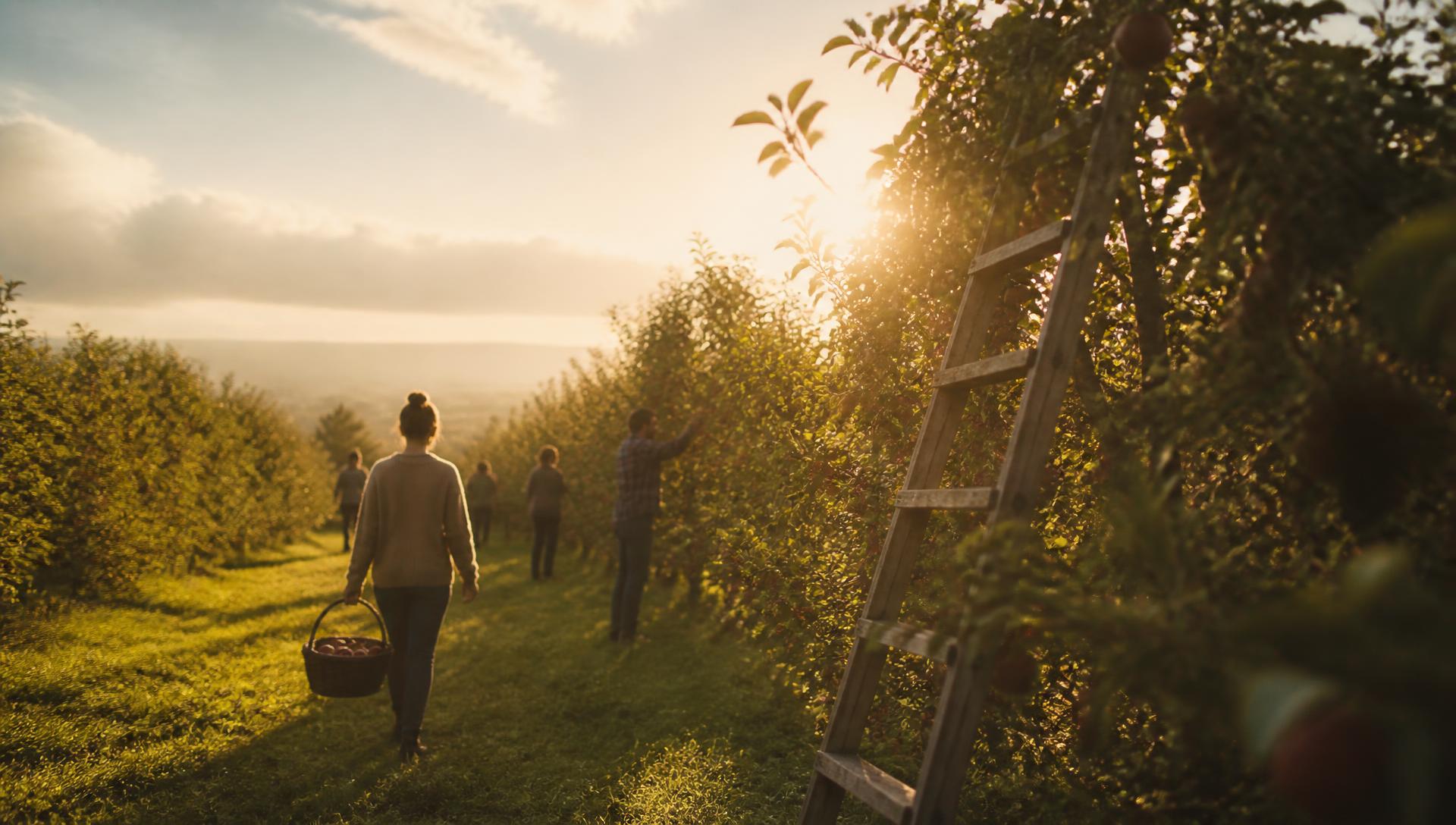
A u-pick farm sells the one thing insurance hates most: unsupervised members of the public, at height, on ground nobody has walked since dawn.
Everything an underwriter asks about a pick-your-own operation is really one question restated — how quickly does someone in a uniform reach a customer who has just fallen out of a tree three rows deep? Farms that can answer that with a written procedure and a staffing ratio get priced as farms. Farms that cannot get priced as attractions. The second, quieter question sits underneath the first: what happens to the produce and the people once they leave the row. A visitor who eats an unwashed berry, a family that lingers past dusk near an unlit irrigation ditch, a child who wanders three blocks over while a parent settles the weigh-out bill — none of these show up in a conversation about ladders, yet each is a live claim scenario that a carrier has seen before on a nearly identical account. The farms that get the best terms are not necessarily the safest in absolute terms; they are the ones whose owner can describe, block by block, exactly where supervision thins out and what specific control closes that gap, because that is the only information an underwriter can actually price against.
- Severity driver
- Falls from ladders and reach height
- Fastest rating win
- A documented, enforced no-ladder rule
- Quietest exposure
- Produce eaten unwashed in the block
The rating case is made at the row, not on the application
Reach height, crate placement, and who is allowed to leave the ground decide how a u-pick account is classed long before an underwriter reads a loss run.
- 6 ft
- Reach height above which appetite narrows sharply
- 1:1
- Roving staff to open block ratio carriers look for
- 0
- Customer ladders in a clean submission
Direct answers
What growers actually ask us
What is u-pick farm insurance?
Farm liability written to include commercial public access for pick-your-own harvesting. It covers customers in orchards, berry fields, and produce rows, plus the retail, weighing, and parking areas that support them, and typically adds products liability for produce taken home or eaten on site.
What are the main claim types?
Falls from ladders or uneven ground, allergic reactions and foodborne illness, insect stings, vehicle contact in field parking, and injuries around farm equipment operating during public hours.
What improves terms fastest?
Removing customer ladder use, documenting the spray log and block closures, marking a single pedestrian route through parking, and installing statutory agritourism signage to the state's prescribed wording.
How is a u-pick farm rated differently from a retail farm stand?
A farm stand concentrates the public at one supervised counter with no exposure to crop, chemical, or terrain hazards. U-pick disperses the same public across open, uneven acreage with dispersed or absent supervision, so the class is rated on reach height, staffing ratio per open block, and chemical program rather than on square footage of retail space.
What should a grower disclose about hired seasonal labor working alongside customers?
Any picking crew, guide, or weigh-station attendant working the same blocks as the public during open hours, including H-2A or day labor, because their presence changes both the workers' compensation classification and the supervision ratio a carrier is underwriting for public safety.
How does storm or hail damage change the underwriting picture mid-season?
A damaged block reopened to the public needs the same pre-opening hazard walk applied at the start of the season, because broken limbs and ground debris are new hazards distinct from the ones present when the block was first approved for picking, and carriers view a re-walk as evidence the farm treats mid-season changes with the same discipline as opening day.
Site
The customer journey, read as an exposure chain
Arrival and parking
Field or verge parking with families unloading strollers and wagons, often adjacent to moving farm traffic.
- Attended parking
- Single walking route
- Speed limit posted
Check-in and briefing
Container issued, rules explained, allergen and consumption position stated, waiver or acknowledgement taken.
- Scripted brief
- Statutory signage
- Container control
Transport to block
Walk or wagon ride to the open block; wagons carry the same severity profile as any passenger transport.
- Full stop boarding
- Rails maintained
- Trained drivers
Picking in the block
Unsupervised harvesting on uneven ground, with reach height, insects, and irrigation lines as the live hazards, spread across acreage no single staff member can watch continuously through a full shift.
- No customer ladders
- Row walk before opening
- Roving staff
Weigh-out and retail
Queueing, produce handling, packaged goods, and often a café or bakery in the same building, where allergen exposure and food-handling practice matter as much as anything that happened in the field.
- Wash-water standard
- Allergen labelling
- Queue management
Underwriting
Seven facts that set your rate
| Underwriting factor | Why it matters | How it can change appetite |
|---|---|---|
| Crop and reach height | Strawberries at ground level and standard apple trees are entirely different fall exposures. | Dwarf or trellised plantings that keep picking below shoulder height are the strongest single rating improvement available. |
| Customer ladder use | Falls from height dominate u-pick severity. | Permitting customer ladders narrows the market sharply; a documented no-ladder rule broadens it. |
| Open acreage vs supervision | The ratio of staff to open blocks determines how quickly a hazard is found and a customer is reached. | Opening more blocks than can be walked and staffed is a common cause of surcharge. |
| Chemical program | Re-entry and pre-harvest intervals must gate which blocks are open to the public. | A written spray log tied to a block-closure procedure is now close to a minimum expectation. |
| Food service and packaged goods | Cider, bakery, and prepared food add a distinct products and illness exposure. | Unpasteurised cider in particular is separately underwritten and sometimes excluded. |
| Ancillary attractions | Mazes, animals, play areas, and rides are each their own class layered onto the picking season. | The more attractions, the more the account is rated as agritainment rather than as a farm. |
| Peak-day attendance | A single autumn weekend can carry a third of the season's visitors and all of its congestion risk. | Timed-entry booking that flattens peaks is viewed favorably and reduces parking-area claims. |
Coverage
The program, layer by layer
Farm liability with agritourism grant
Public access for commercial picking, explicitly scheduled — the base grant everything else attaches to.
Confirm u-pick is named in the schedule
Products liability
Produce eaten in the field or taken home, plus cider, bakery, jam, and anything else sold from the farm store.
Wagon transport endorsement
Where customers are carried to and from blocks behind a tractor, with conditions on the equipment and driver.
Farm property and equipment
Barns, farm store, cold storage, tractors, and irrigation infrastructure.
Crop insurance
The harvest itself against hail, frost, drought, and disease — separate from any liability discussion.
Workers' compensation
Permanent and seasonal labour, including any H-2A workforce, with distinct classification from the retail staff.
Umbrella / excess
Standard once attendance, food service, or attractions push the account past a small-farm profile.
Claims scenario
How a single ladder decision becomes a claim
A grower's submission states, correctly, that customers are not permitted to climb. On a busy Saturday a father boosts his ten-year-old onto a low branch to reach fruit two feet above her head, a staff member fifteen rows away does not see it happen, and the child falls onto a root ball and fractures a wrist. The farm's policy responds, but the adjuster's first question is not about the fall — it is about whether the no-climbing rule was enforced, or merely posted. A signed briefing acknowledgment, a photograph of the posted signage, and a written record of roving staff assignments that day are the difference between a routine bodily-injury claim and a coverage dispute over misrepresentation on the original application.
The same logic runs through nearly every u-pick loss. A wasp sting becomes a severe anaphylactic reaction because no one on site knew the visitor carried an epinephrine auto-injector and staff hesitated to use one that was not their own. A stomach illness traced to a berry block becomes a multi-family claim because the spray log shows the block was opened four days before its labeled re-entry interval expired. None of these are exotic scenarios — they are the ordinary consequence of a control that existed on paper but was not the practice on the ground on the day it mattered.
A third pattern shows up at the edges of the season rather than in the middle of it. A grower who has run a clean summer berry season adds a weekend corn maze and a flashlight-lit evening hayride for October without calling the broker, assuming the existing farm liability policy simply extends to whatever the farm decides to do on its own land. A visitor twists an ankle in the dark maze, and the carrier's adjuster finds the activity was never disclosed, never rated, and never added to the schedule. The claim may still be covered under a broad reading of the farm liability grant, but the more common outcome is a reservation-of-rights letter and a renewal at a materially different price once the carrier learns the full scope of what actually happens on the property across the calendar year, not just during the picking window the original submission described.
Loss control
Controls that change the price
Hazard
Customer climbs a tree or brings their own ladder.
Control
Posted and briefed no-climbing rule, staff-only picking above shoulder height, and roving staff empowered to stop it.
Hazard
Allergic reaction or illness after eating in the field.
Control
Clear allergen and wash-before-eating signage, documented sanitation standard, and a stocked first-aid point with trained staff.
Hazard
Block opened inside a chemical re-entry interval.
Control
Spray log that mechanically drives a block-open list, with physical closure of any block inside its interval.
Hazard
Child separated from a group across open acreage.
Control
Defined block boundaries, marked exits, a lost-child procedure, and a staffed check-in point.
Hazard
Vehicle contact in overflow field parking on a peak weekend.
Control
Timed-entry capacity management plus attended parking and a fixed pedestrian corridor.
Hazard
Visitor trips on irrigation line or pump equipment left in an open row.
Control
Pre-opening row walk that specifically clears and flags infrastructure, not just checks fruit condition.
Hazard
Undisclosed farm dog or livestock guardian contacts a visitor near parking.
Control
Written leash and containment policy, disclosed to underwriting, with any customer-facing animal contact separately scheduled.
Contracts
Who is asking for what
Layer 01
Landowner or leased-block agreement
- Typically asks for
- AI status and a clear statement of which blocks are covered where a grower leases additional acreage for the season.
- Where it goes wrong
- A leased block opened to the public without the lease naming that acreage on the schedule.
Layer 02
Agritourism statute compliance
- Typically asks for
- Posted signage in the state's prescribed wording, which is a condition of the statutory liability limitation in most states that offer one.
- Where it goes wrong
- Signage present but not in the required wording, which can void the statutory protection entirely.
Layer 03
Third-party food or beverage vendor
- Typically asks for
- Their own products liability and a certificate naming the farm as additional insured for any cider, bakery, or prepared food sold under their own brand.
- Where it goes wrong
- A guest vendor's cart treated as covered under the farm's policy with no certificate on file.
Layer 04
School and group bookers
- Typically asks for
- A stated group size cap and a written supervision expectation before a bus of visitors arrives unannounced on a peak Saturday.
- Where it goes wrong
- A booked group larger than the farm's staffing plan overwhelming a single roving attendant.
Layer 05
Attraction subcontractor (maze, hayride, or amusement operator)
- Typically asks for
- Their own liability certificate naming the farm as additional insured, and written confirmation that their equipment inspections are current for the season.
- Where it goes wrong
- A seasonal maze or ride vendor operating under the farm's name with no certificate on file when the season opens.
Season calendar
How the u-pick year is underwritten
Late winter
Pre-season planning
Reach-height pruning decisions, spray program planning, and ladder policy set before the schedule is submitted for renewal, along with a review of any new attraction the farm intends to add for the coming season.
Early spring
Placement and endorsement
U-pick grant, products liability, and any wagon or ancillary attraction endorsements confirmed before the first bloom.
Summer through fall
Peak public season
Daily block-opening decisions gated by the spray log, staffing ratios held to the plan on peak weekends.
Post-harvest
Close-out and review
Incident log reviewed, loss runs updated, reach-height or ladder policy adjusted ahead of next year's submission, and any mid-season storm or attraction changes formally reconciled against the current schedule.
Submission
The submission that gets quoted first
015 items
The operation
- Crops offered for u-pick and their picking heights
- Total acreage and acreage open to the public
- Season dates and projected attendance including peak day
- Admission, per-container, or by-weight pricing model
- Any dogs, livestock, or animals present on or near visitor areas
024 items
Hazards
- Ladder policy in writing
- Whether wagon transport is used and the route
- Food, cider, and bakery operations including pasteurisation
- Every ancillary attraction, including animals and play areas
035 items
Controls
- Spray log format and block closure procedure
- Pre-opening hazard walk checklist
- Photographs of statutory agritourism signage
- Incident log and three to five years of loss runs
- Cell coverage gaps and any radio or alternate communication plan
Glossary
U-pick placement language, translated
Products liability
Coverage for illness or injury arising from produce, cider, or baked goods that leave the farm's control — whether eaten in the field or taken home — as distinct from a slip-and-fall on the premises.
Re-entry interval
The regulated waiting period after a pesticide application before people may safely enter a treated block. Opening a block to the public inside that window is both a regulatory violation and a direct liability exposure.
Agritourism statute
A state law limiting a farm's liability for inherent agricultural risks, conditioned on posting specific, prescribed warning language. Signage that does not match the statute's exact wording can void the protection entirely.
Additional insured (AI)
A landowner or vendor added directly to the grower's liability policy, so a claim against them arising from the u-pick operation is defended and paid under that policy.
Waiver of subrogation
A promise that the farm's carrier will not pursue a landowner or vendor after paying a claim, even where that party shares some fault. Lease and vendor agreements frequently require it.
Statutory signage
Warning signs posted in a state's exact prescribed wording at the entrance to a u-pick operation, required as a condition of the state's agritourism liability limitation.
Reservation of rights
A carrier's written notice that it is investigating or defending a claim while reserving the right to later deny coverage, typically issued when an activity or exposure was not clearly disclosed at underwriting.
Scheduled attraction
An activity, such as a maze, wagon ride, or animal contact area, explicitly listed on the policy so its exposure is rated and covered rather than assumed to fall under the base farm liability grant.
Routing
Where your season overlaps
Farm tour insurance
Guided or school tours run alongside the picking season.
Christmas tree farm insurance
The same land runs a winter choose-and-cut season.
Pumpkin patch insurance
Autumn is the dominant season with mazes and attractions.
Agritainment insurance
Attractions now outweigh the harvest as the reason visitors come.
Related coverage
Explore Coverage
Guides & resources
FAQ
U-pick questions
What makes u-pick harder to insure than farm retail?
Supervision density. A farm stand concentrates the public at one controlled point; u-pick disperses them across acres with no staff in sight, on ground the farm cannot inspect continuously. Underwriters price that loss of observation directly.
Should customers be allowed to use ladders?
Most appetites either exclude customer ladder use or condition it heavily. Falls from height are the highest-severity u-pick claim. Farms that go ladder-free by pruning to a reachable height, or by restricting picking to trained staff above shoulder height, get materially better terms.
Is eating in the field a covered exposure?
It is a products and foodborne-illness exposure whether or not the farm intends it, because customers will eat unwashed produce. Products liability, a documented wash-water and sanitation standard, and clear allergen signage are all part of the conversation.
How do pesticide applications affect the public season?
Every product has a re-entry interval and a pre-harvest interval. Opening a block to customers inside a re-entry window is both a regulatory breach and a straightforward liability claim. Carriers increasingly ask to see the spray log and the block-closure procedure.
Do waivers work at a u-pick?
Partially and inconsistently. Enforceability varies by state, several states will not enforce a parent's waiver on behalf of a minor, and no waiver defends against negligence. They are worth having as evidence of communicated risk, not as a substitute for coverage or controls.
How does insect activity factor into pricing?
Bee and wasp stings are a routine u-pick claim, particularly in berry rows and orchard blocks in late summer. Underwriters look for a stated allergy-awareness policy, an accessible epinephrine plan for staff, and hives kept a documented distance from picking rows rather than treated as an unavoidable hazard.
What happens to coverage during a farm's off-season events?
Many u-pick operations run a fall festival, a holiday market, or corn maze alongside the picking season on the same acreage. Each of those is its own exposure class and needs to be scheduled by name; a policy written narrowly for u-pick harvesting does not automatically extend to a hayride or a maze added the same autumn.
Is a written emergency action plan actually required?
Most carriers now ask for one as a submission item rather than a nice-to-have. At minimum it should name who calls 911, where the nearest vehicle access point is for each block, how a lost child is reported, and how a chemical or weather event triggers a field-wide evacuation.
What does 'additional insured' mean for a leased-acreage arrangement?
It means the landowner leasing the block to the grower is added directly to the grower's liability policy, so a claim arising from a leased block is defended and paid under that policy, rather than the landowner relying on the lease's indemnity language alone.
Why do underwriters ask about picking height before anything else?
Because it predicts the single largest severity driver on the class. A strawberry field picked at ground level and a full-height apple orchard picked with ladders are functionally different risks wearing the same 'u-pick' label, and the submission that states reach height up front gets a faster, better-informed quote.
How should a u-pick farm handle a multi-family bee sting incident during peak weekend traffic?
Treat it as a staffing and communication test, not a single claim. Carriers want to see a stated protocol: a first-aid attendant reachable within minutes anywhere on open acreage, a posted allergy notice at check-in, hive placement documented at a fixed distance from picking rows, and an incident log that captures every sting even when no treatment beyond ice is needed, because a pattern of untreated stings at one block is itself evidence a hive location needs to move before it produces a severe anaphylactic claim.
What is the exposure when a u-pick operation also runs a corn maze or hayride the same autumn?
Each attraction is underwritten on its own loss profile and has to be named on the schedule; a farm liability form written narrowly around fruit and vegetable harvesting does not automatically pick up maze navigation hazards, tractor-drawn wagon transport, or nighttime flashlight events. Farms that stack attractions onto the same acreage without updating the schedule commonly discover the gap only after a claim, when the carrier points out the activity was never disclosed at renewal.
How does irrigation equipment left in the field factor into the risk picture?
Drip lines, above-ground risers, and portable sprinkler pipe sitting in a block that is about to open to the public are a routine trip-and-fall source that many growers underestimate because staff step over them without thinking. Underwriters ask whether irrigation infrastructure is cleared, flagged, or routed along row edges before a block opens, since a customer distracted by a picking bag rarely watches the ground the way a farmhand does.
Does the farm's insurance respond if a customer's dog bites another visitor in the parking area?
Only if dogs are permitted on the property and the farm's liability policy has not carved that exposure out, which many do for certain breeds or off-leash situations. A written leash policy, posted at the entrance and enforced by staff, is the control underwriters look for; farms that allow dogs without any stated rule are treated as having a live animal-liability exposure whether or not the farm owns any animals itself.
How does a hail or frost event mid-season change the insurance conversation, not just the crop conversation?
A damaged block often gets reopened to the public at a reduced picking rate rather than closed outright, which can quietly change the hazard profile — broken branches, downed limbs, and debris on the ground are new trip and impalement risks that were not present when the block was originally walked and approved for opening. Growers who reopen a storm-damaged block should re-walk it under the same pre-opening protocol used at the start of the season, not simply resume the prior schedule.
What should a u-pick operation do about cell service dead zones across large acreage?
Blocks far from the farm stand or parking area often sit in a mobile dead zone, which delays both a customer's ability to call for help and staff's ability to respond to a radio call. Carriers increasingly ask whether the farm has a two-way radio system independent of cell coverage and a documented response time target for the furthest picking block from the first-aid point.
How does a u-pick farm document consent for photography and video used in marketing?
This sits outside the liability conversation but often surfaces at renewal when a farm's social media shows children's faces without any visible consent process. A posted photography notice at entry, consistent with the state's right-of-publicity rules, is a low-cost practice that some brokers now flag during the annual review alongside the safety controls, since it reduces an unrelated but real category of claim.
What underwriting difference exists between a single-crop u-pick and a diversified operation offering strawberries, apples, and pumpkins across the same season?
A diversified operation multiplies the number of distinct hazard profiles a single staffing plan has to cover across a longer calendar, since ground-level berry picking, mid-height orchard work, and a fall pumpkin field each carry different reach-height, ladder, and vehicle-traffic considerations at the same time. Carriers generally ask diversified growers to submit a block-by-block breakdown rather than a single acreage figure, because averaging the hazard across the whole property tends to understate the riskiest block on the farm.
How should a grower price the liability exposure of adding overnight camping or agritourism lodging to a u-pick property?
Overnight stays introduce an entirely different exposure class — fire and life safety, security, and extended-hours supervision — that a daytime picking liability form was never built to price, so it needs to be underwritten as lodging or short-term rental exposure layered onto the farm program, with its own life-safety equipment, egress, and staffing review rather than treated as an extension of the harvest-season visit.
Does adding a farm wedding or private event booking change the u-pick liability profile?
Yes — a private event with alcohol service, evening hours, and a contracted guest count is underwritten as a separate special-event exposure with its own liquor liability and venue considerations, distinct from daytime public picking access, and most agritourism forms require it scheduled by date rather than assumed under the farm's general operating liability.
Send the crop list and the ladder policy
Picking height, ladder rules, and peak-day attendance are the three facts that move a u-pick quote most. Send those and we will tell you where the account sits.
General information about how pick-your-own placements are commonly structured. Agritourism statutes, waiver enforceability, and chemical re-entry rules are jurisdiction-specific. Not legal advice; nothing here confirms coverage.